Internal Temp of Ground Beef at Home
Ah, summer. The fizz of the bees, the laughter of the children running through the sprinklers, the sizzle of burgers overcooking on the grill…
Expect. No. Not that! Not onyour grill! Equally outdoor cooks, I think we all need to go serious about that staple of the grill, the hamburger. There are literally millions of ways you can prepare burgers, each with unlike seasonings, different toppings, different stuffings, just theyall demand to be cooked properly to preclude foodborne illness and ensure only the right tenderness and juiciness.
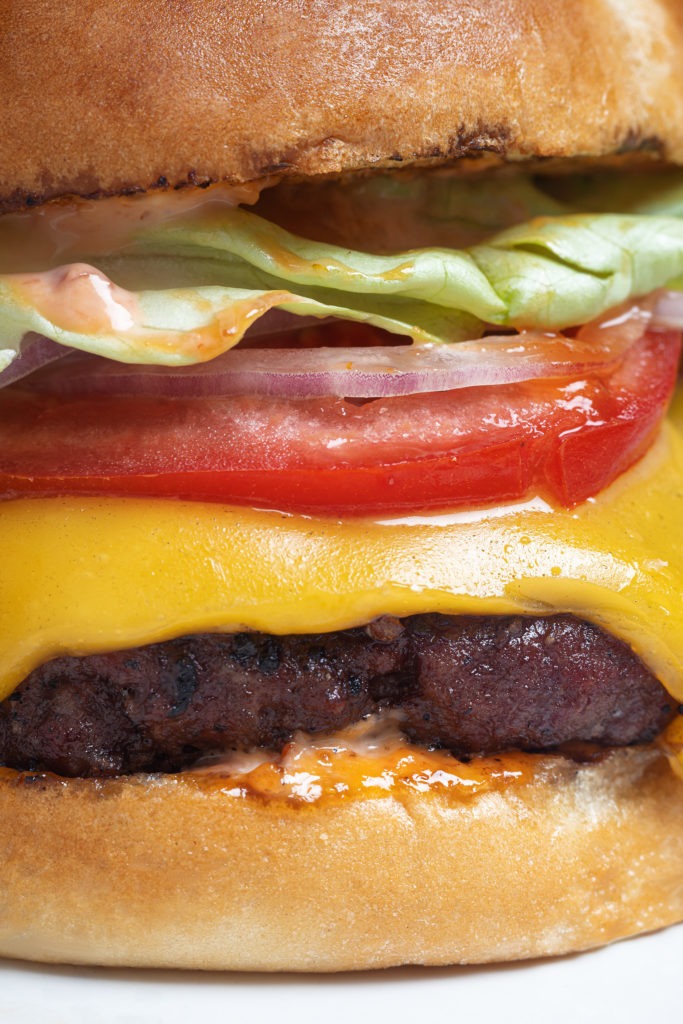
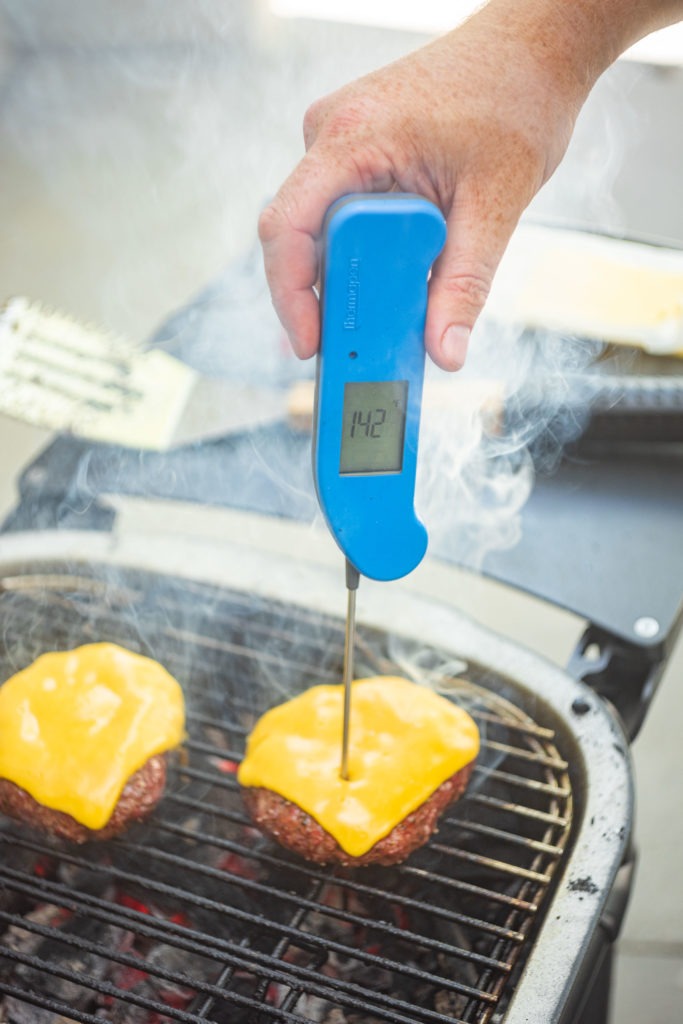
Safe burger temp: 160°F
To help you lot prepare for all the grilling yous'll practise this summertime, we've washed the thermal legwork so that you lot can brand prophylactic, tasty, impressive burgers for your family and friends.
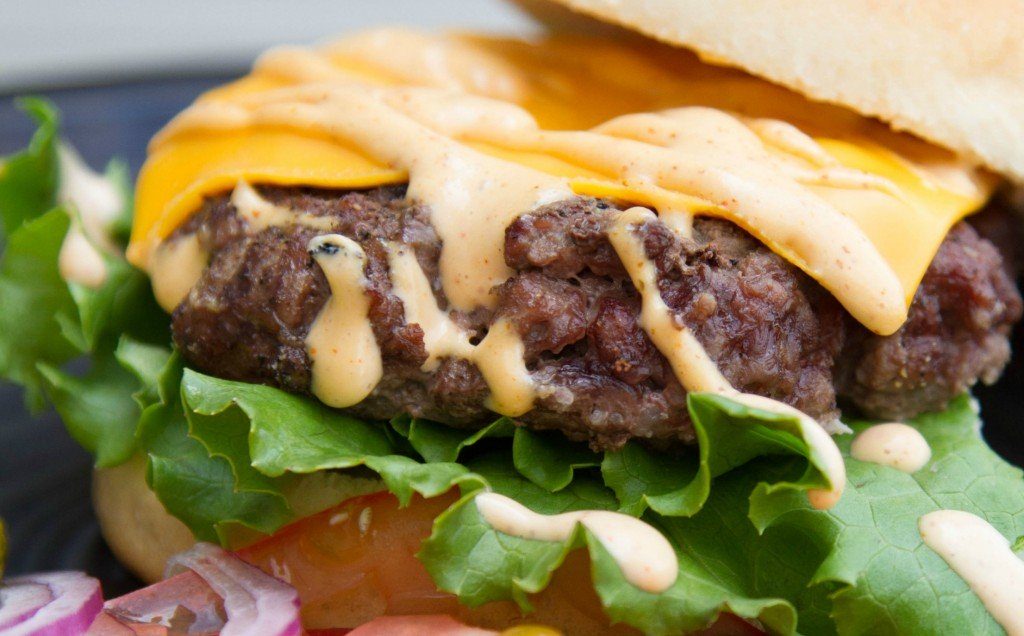
Grilled hamburger temperature basics
First, permit'due south lay down the basis rules. Store-bought ground beefiness must be cooked to an internal temperature of 160°F (71°C) to be considered safe to swallow. Why is that, when I can eat a medium-rare steak that is 30°F (17°C) cooler? Because of the grinding procedure itself. You see, bacteria don't tunnel or even endeavour to travel at all, and that ways that pretty much all the bacteria on a steak are living on the surface. If you sear a steak at a loftier temperature, y'all'll kill the bacteria on the outside, only since in that location aren't any inside, you don't have to worry virtually them.
But if yougrind that steak up and turn it into a ribeye burger (yum), yous've taken all the bacteria living on the outside of the steak and distributed them throughout your patty. And since any piece of meat is simply every bit cooked equally itsleast cooked part, you demand to cook the ground beef to160°F (71°C) to ensure it is safe to eat. Of class, with carryover cooking, that means you'll desire to pull your burgers at 155°F (68°C) to reach the all-time temp possible.
Ok, basics out of the way, let's talk a piddling about nuance. There is a way to curve those rules by grinding your own meat for your burgers. If yous buy your ground beef prepackaged, you don't know what cuts were used, how long it has been mixed together, or anything else. If you lot purchase a piece of good, well-marbled chuck and grind it fresh just minutes earlier you grill it, you have more than knowledge nigh—and less risk from—your burgers. Not only can you cook a home-footing burger to an astonishingly juicy medium rare (130–135°F [54–57°C]), but yous tin choose the flavor profile of your burger by lilliputian with the ratios of different cuts you use.
That being said, yous may already have purchased ten pounds of ground beef for a weekend cookout, and that's fantastic. Permit's talk about how to cook that the best mode yous can.
Notation: the principles we'll discuss below can too be applied to home-ground burgers. Merely conform the temperatures appropriately.
How to grill the best burgers
The best manner to hit your temperature target when grilling burgers is to use the two-stage cooking method. The two-phase method means setting up your grill with a lower-heat department and a high-heat section. You lot commencement your food on the unheated side, allowing only the ambient heat from the hot side to cook it. When you come up inside range of your desired last temperature, y'all motility the meat to the hot side for a concluding sear. This is different than the standard method that nearly people use: slapping burgers directly over loftier oestrus and cooking them until they are "done."
Why cook burgers in two stages?
If y'all're wondering what the betoken is, why bother with a two-stage melt, the respond is this: control. By approaching the final temperature more slowly, you go on the thermal "momentum" in your burgers low, thus making it easier to striking your target pull temperature.
To show this is truthful, we cooked 5 oz burgers (though we like cooking viii oz burgers even more than!) over direct heat and over indirect heat followed by a sear and nosotros recorded the data to see the differences. To perform the experiment, we used an armor cable Blazon-K thermocouple probe and a ThermaQ ® Blue. And at this indicate, I need to say something nigh our method. Nosotros practise not, as a rule, propose people to use exit-in probes when cooking directly over high heat, every bit in the example of grilling. Using leave-in probes is fine for the initial stage of 2-phase cooking, where the probe and wire can be kept away from loftier oestrus, but they are not generally advised for searing. Most probe transitions and wires tin can't stand up to the kind of oestrus that is frequently institute in a grill full of burgers. A hot grill can well exceed the safe range for most probe transitions, especially if there are 1200°F (649°C) flare-ups from the fatty dripping onto the flame! (For more nuance on that topic, run across our postal service about grill types and their heat signatures or our post on grilling with exit-in probes.)
The armored probe can accept more heat than nearly probes, and nosotros thought it worth the risk to show you the difference in the ii methods. (Incidentally, the probe performed admirably and didn't burn down out.)
Directly estrus grilling
When we cooked the burgers over direct rut, their temperature ascent was steep and swift. Take a await at the graph of how long it took to get from cold meat to done:
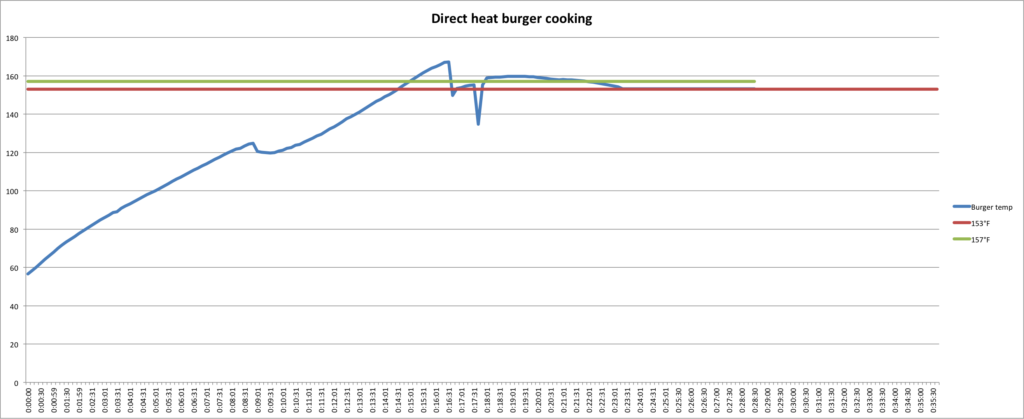
You tin see a couple of things. I've set lines at 153°F (67°C) and 157°F (69°C) then that you lot tin come across in what a short range of time your pull temp occurs. The time from when the beef hits153°F (67°C) until it reaches157°F (69°C) is only about xxx seconds. That's a pretty short window that tin can hands exist missed if you aren't paying attention, despite using a super-fast Thermapen ® ONE.
One way to understand this is to think of the gradients in the meat. Since the temperature difference between the within and the exterior is quite farthermost, the temperature curve from the center outward is quite steep. This means that the temperature will be changing quickly throughout the burger. It's easy to overshoot a target when the temps are changing so rapidly! And in fact, though we took these burgers off the heat at153°F (67°C), you lot can see that the carryover cooking took them past the160°F (71°C) nosotros were aiming for. At our grill heat, nosotros could have taken them off a few degrees earlier and been rubber.
(I included the resting catamenia on the correct in this graph to make the timescales equal on the two graphs. You can compare and see how much steeper the temperature climb was in this initial cook than in the graph beneath.)
Two-phase grilling
For our two-stage cooking, we cooked the burgers away from the heat with the grill lid closed until their temperature reached 135°F (57°C). When we cooked the burgers at a lower temperature outset, nosotros advisedly narrowed the range of temperature gradients present in the patties. Our gradients were smaller, and that meant that the temperature change was slower when we somewhen put them on the hot side for searing.
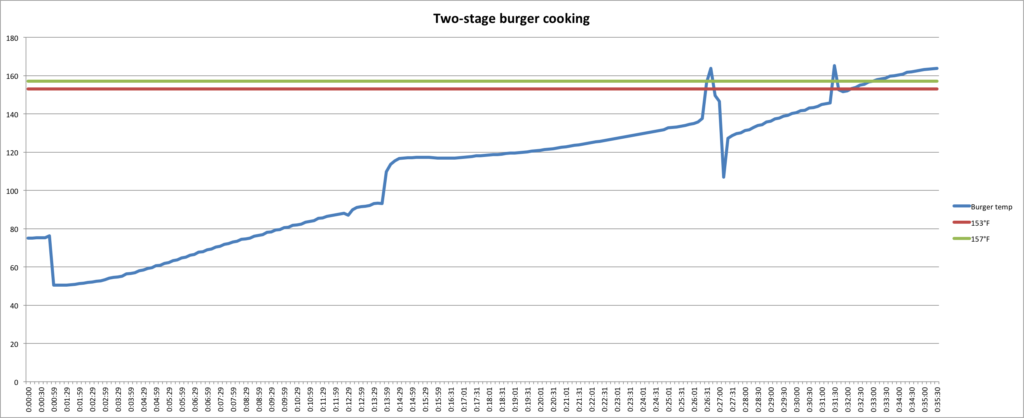
A few things can be gleaned from this graph. First, you can see where my probe thermometer wasnon in the thermal center at the very beginning. Verifying the thermal center with a Thermapen is essential for proper cooking! And we quickly readjusted the position of the exit-in probe.
But in relation to what we're focusing on hither, the time between153°F (67°C) and 157°F (69°C) in this case was over one minute,twice the time of the straight-cook burgers. That means yous have twice the chance of getting properly cooked, tasty burgers! And with less thermal momentum, at that place was as well less carryover cooking, which means yous are also less likely to finish up with overcooked burgers one time they leave the rut.
As discussed in a higher place, this same method tin can be applied to domicile-ground burger patties, with even tastier results. Cook over indirect estrus until mosttwenty°F (11°C) below your target temperature, then sear them to your Thermapen-perfect desired temperature. If you want medium-rare, proceed your first stage cook to 110-115°F (43-46°C). But only if you are grinding your own meat!
Conclusion
If your aim is perfect burgers, especially for a crowd, the 2-stage method is the way to get. Use a get out-in probe thermometer for the initial cooking stage and a Thermapen 1 to finish your burgers on the hot side and you'll go exactly the results you're looking for. The more-gentle initial cooking decreases thermal momentum and gives you lot a target-temperature window that is twice every bit long as the 1 you get from directly cooking. So better your burger game this summer, and boot your burgers into a higher gear!
Products used in this mail service:
Salvage Salve

Source: https://blog.thermoworks.com/beef/grilling-hamburgers-a-temperature-guide-2/
0 Response to "Internal Temp of Ground Beef at Home"
Post a Comment